Heat Pumps Edinburgh
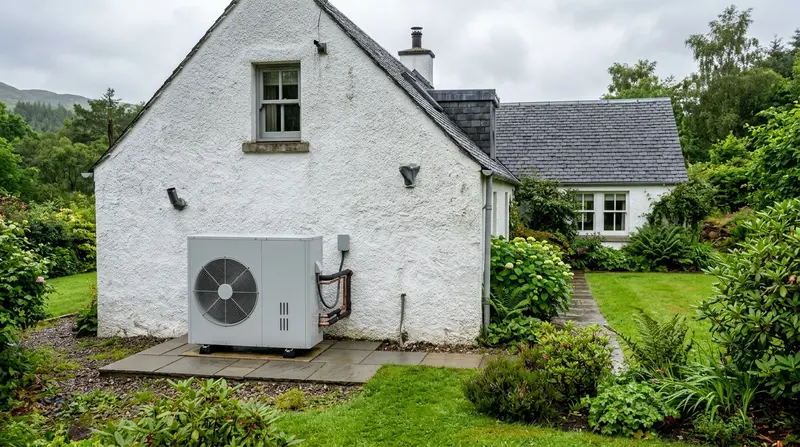
Air Source Heat Pumps for Edinburgh Homes
An air source heat pump can heat your Edinburgh home and hot water efficiently, even through a Scottish winter. Every installation is priced at survey: the installer assesses your property's heat demand first, and your price is confirmed on your written quote. Loans available, subject to status.
Edinburgh Solar Hub is part of Scottish Energy Efficiency — an impartial advisory service, not an installer. We install through MCS-certified partners.
How Air Source Heat Pumps Work
An air source heat pump (ASHP) extracts heat from outdoor air — even when temperatures drop below freezing. Using a refrigerant cycle similar to a fridge running in reverse, the pump absorbs low-grade heat from outside, compresses it to a higher temperature, and transfers it into your central heating system and hot water cylinder.
The key metric is the Coefficient of Performance (COP). A typical ASHP achieves a COP of 2.8–3.5, meaning for every 1 kWh of electricity consumed, it delivers 2.8–3.5 kWh of useful heat. That's 280–350% efficient — compared to a gas boiler's theoretical maximum of around 92%.
Edinburgh's maritime climate is genuinely well-suited to heat pumps. Winter temperatures in the city rarely drop below −5°C, and heat pumps are most efficient between 2°C and 7°C — exactly the range of a typical Edinburgh winter day. Modern units continue operating effectively down to −15°C or lower, though efficiency decreases at extreme cold.
Heat pumps work best with good insulation. During your installer's home survey, they'll check your property's thermal performance and recommend any improvements (loft insulation top-up, draught-proofing) that will help the heat pump run efficiently.
Book your heat pump assessment
Pricing, Funding and Finance
What's Included
A fully installed air source heat pump system typically includes: the outdoor heat pump unit, a hot water cylinder (usually 170–250 litres), system controls and thermostat, pipework modifications to connect the heat pump to your existing heating distribution, and all electrical work including the dedicated circuit.
What Shapes Your Quote
- Property size: Larger homes need higher-capacity heat pumps (e.g., 12–16 kW vs 5–8 kW for a smaller property).
- Radiator upgrades: Heat pumps run at lower flow temperatures (35–45°C vs 60–70°C for gas boilers). Some radiators may need upsizing — though many homes only need a few changed, not all.
- Pipework complexity: Older properties may need more extensive pipework modifications.
- Hot water cylinder: If you currently have a combi boiler (no cylinder), one will need installing, which requires space.
Funding and Finance
- Price: Priced at survey. Confirmed on your written quote.
- Finance: Loans available, subject to status.
- Means-tested support: Some schemes exist for lower-income households. We will tell you honestly if you might qualify.
Call 0141 230 0198 to discuss your options →
Energy Use: Heat Pump vs Gas vs Oil
The table below compares the illustrative fuel needed to heat a typical 3-bed semi-detached home with a heat demand of 15,000 kWh. These are illustrative only — your actual energy use depends on your property size, insulation and usage patterns.
| Heating System | Efficiency | Fuel Used (est.) |
|---|---|---|
| Gas Boiler | 90% | 16,667 kWh gas |
| Oil Boiler | 85% | 17,647 kWh oil |
| ASHP (COP 3.0) | 300% | 5,000 kWh elec. |
Assumptions: 15,000 kWh annual heat demand (typical 3-bed semi). Running costs depend on your tariff and usage. We do not guarantee any level of savings. Any savings estimate is confirmed on your written quote.
Several factors affect how a heat pump performs for you:
- Heat pump tariffs: Some suppliers offer tariffs designed for heat pump owners, with cheaper overnight rates.
- Solar panel offset: Combining a heat pump with solar panels lets you generate some of the electricity the pump uses — particularly effective from March to October.
- Simple maintenance: No annual boiler service required. Heat pumps need a simple service every 1–2 years.
- Insulation: A well-insulated home needs less heat, so the heat pump uses less electricity.
Get a heat pump assessment for your home
Installation by MCS-Certified Partners
We install through MCS-certified partners. Warranty and guarantee terms are confirmed in writing on your quotation.
What the Installation Process Looks Like
- Home survey: A qualified surveyor visits your property to assess heat demand, insulation, radiator sizes, hot water requirements and outdoor unit placement. This is without obligation.
- System design: The installer designs a bespoke system specification based on room-by-room heat loss calculations, selecting the right heat pump capacity and identifying any radiator upgrades needed.
- Written quote: You receive a written quote setting out the price, finance options and warranty and guarantee terms.
- Installation: Typically 2–3 days. This includes mounting the outdoor unit, installing the hot water cylinder, connecting pipework, fitting controls and performing electrical work.
- Commissioning: The installer commissions the system, sets up controls and monitoring, and walks you through operation. You receive your MCS certificate.
Call 0141 230 0198 to book your home survey →
Frequently Asked Questions
How noisy is an air source heat pump?
Modern air source heat pumps operate at around 40–45 dB at one metre — comparable to a fridge or a quiet conversation. At three metres (a typical distance from a neighbouring property boundary), this drops to roughly 35 dB. Planning regulations in Scotland require the unit to meet noise limits at the nearest neighbouring property boundary. Your installer will advise on the best placement to minimise noise, including vibration-dampening mounts.
Do I need to replace my radiators?
Not necessarily. Heat pumps operate at lower flow temperatures than gas boilers (typically 35–45°C vs 60–70°C), so some radiators may need upsizing to deliver the same warmth. During the home survey, the installer performs a room-by-room heat loss calculation and identifies which radiators (if any) need upgrading. Many homes only need a few radiators swapped, not a full replacement. Underfloor heating works excellently with heat pumps and rarely needs changes.
How can I pay for a heat pump?
Loans available, subject to status. Some means-tested schemes exist for lower-income households, and we will tell you honestly if you might qualify. Your price is set after a survey of your home and is confirmed on your written quote.
Can I combine a heat pump with solar panels?
Absolutely — it's one of the best combinations you can make. A heat pump typically uses 4,000–5,500 kWh of electricity per year. Solar panels generating at 894 kWh/kW can offset a meaningful portion of that. A 4 kW solar system could cover a meaningful share of your heat pump's electricity consumption, particularly in spring and autumn. Add a battery and you can shift even more solar energy to when the heat pump needs it most.
Get Your Heat Pump Assessment
No obligation. We'll assess your property, calculate heat demand and provide a written quote. Loans available, subject to status. Covering every EH postcode in Edinburgh.
We install through MCS-certified partners. Edinburgh Solar Hub is an impartial advisory service — we do not install.