Battery Storage Edinburgh
Home Battery Storage & Arbitrage in Edinburgh
Home battery storage in Edinburgh is priced at survey, depending on capacity, chemistry and whether you're adding to an existing solar system or installing alongside new panels. In Scotland's climate, grid arbitrage — not just solar storage — is a major part of a battery's value. 0% VAT on solar panels and batteries until 31 March 2027. Here's what to expect.
Edinburgh Solar Hub is part of Scottish Energy Efficiency — an impartial advisory service, not an installer. We install through MCS-certified partners.
Why Batteries Make Sense in Scotland
Scotland's solar yield of 894 kWh/kW is respectable but lower than southern England, which means there's less excess solar energy to store in a battery. So why are batteries still worth considering here? Because their value isn't only about solar — it's also about the gap between off-peak overnight electricity and peak-time rates.
In Edinburgh, much of a battery's benefit comes from grid arbitrage — charging at off-peak overnight rates and discharging during peak hours. The rest comes from boosting solar self-consumption (storing daytime solar output for evening use).
Unlike solar generation, which drops in winter, arbitrage works all year round. Your battery can cycle in December just as well as in June.
How Grid Arbitrage Works
Grid arbitrage is simple: charge your battery when electricity is cheap, and use that stored energy when rates are high:
- Charge overnight: on an off-peak time-of-use tariff (typically in the early hours)
- Discharge at peak: during the 4–7pm peak window (or throughout the day on a standard variable tariff)
- Your benefit: depends on the gap between your off-peak and peak rates
Illustrative Energy Shifted Each Year
| Battery Capacity | Cycles / Day | Daily Energy Shifted | Annual Energy Shifted (est.) |
|---|---|---|---|
| 5.2 kWh | 1 | ~5.2 kWh | ~1,900 kWh |
| 5.2 kWh | 2 | ~10.4 kWh | ~3,800 kWh |
| 10.4 kWh | 1 | ~10.4 kWh | ~3,800 kWh |
| 10.4 kWh | 2 | ~20.8 kWh | ~7,600 kWh |
| 13.5 kWh | 1 | ~13.5 kWh | ~4,900 kWh |
Important: We cap illustrative calculations at a maximum of 2 cycles per day. Most battery warranties are designed around 1–2 daily cycles; running more accelerates degradation. Figures are before round-trip losses. Your actual benefit depends on your specific tariff, usage patterns and battery degradation over time. Savings confirmed on your written quote.
Solar Self-Consumption Boost
If you have solar panels, a battery dramatically increases how much of your own generation you actually use:
- Without a battery: typical self-consumption is around 30%. The rest is exported to the grid, earning smart Export Guarantee payments, with rates set by each supplier.
- With a battery: self-consumption rises to 60–70%. You store midday solar output and use it in the evening when electricity is most expensive.
Each kWh shifted from export to self-consumption is worth the difference between your import rate and your export rate. A 4 kW solar system producing 3,576 kWh/year could shift an additional 1,000–1,400 kWh from export to self-consumption, on top of arbitrage. Savings confirmed on your written quote.
Call 0141 230 0198 to discuss solar-plus-battery packages →
Battery Options
| Battery | Capacity | Chemistry |
|---|---|---|
| Tesla Powerwall 2 | 13.5 kWh | Lithium NMC |
| Fox ESS ECS | 5.2 kWh | LFP |
| Fox ESS ECS | 10.4 kWh | LFP |
| Sunsynk ECCO | 5.12 kWh | LFP |
| Sunsynk ECCO | 10.24 kWh | LFP |
Priced at survey. 0% VAT on solar panels and batteries until 31 March 2027. Installations include battery unit, hybrid inverter (where required), installation, commissioning and SPEN notification. LFP = Lithium Iron Phosphate — longer cycle life (6,000+) than NMC (~4,000 cycles).
What Affects Your Quote
- Retrofit vs new install: Adding a battery to an existing solar system may require replacing the inverter with a hybrid model or choosing an AC-coupled battery (like the Tesla Powerwall 2) — the survey confirms the best route.
- Capacity: The right capacity depends on your usage, tariff and whether you have solar panels.
- Chemistry: LFP batteries (Fox ESS, Sunsynk) typically offer longer cycle life (6,000+ cycles) compared to NMC (Tesla Powerwall, ~4,000 cycles). LFP is also considered safer and more stable at temperature extremes.
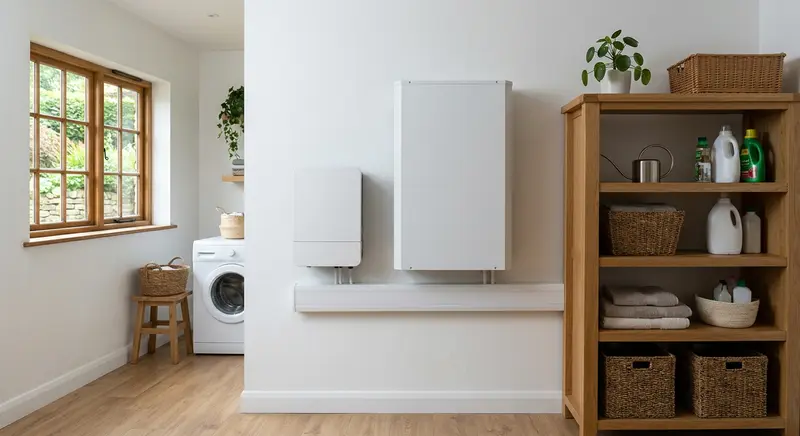
- Installation location: A garage or utility room is easiest. Loft installations, external wall mounting or locations requiring long cable runs add work.
Model Your Own Battery Use
Enter your usage pattern and battery size to see illustrative energy figures for grid arbitrage and solar self-consumption combined.
Open the battery calculatorBattery Brands We Recommend
Tesla Powerwall 2
The premium option. 13.5 kWh usable capacity with a built-in inverter, making it AC-coupled and compatible with any existing solar system. Sleek wall-mounted design with optional backup gateway for power-cut protection.
Fox ESS
LFP batteries paired with Fox hybrid inverters. Available in modular 5.2 kWh units that can be stacked. 6,000-cycle rating and a user-friendly monitoring app. A strong choice for new solar-plus-battery installations.
Sunsynk
A popular hybrid inverter-battery combination in the UK market. LFP chemistry and a detailed monitoring platform with granular control over charge and discharge schedules. Available in 5.12 kWh and 10.24 kWh configurations.
We install through MCS-certified partners. Warranty and guarantee terms are confirmed in writing on your quotation. Discuss which battery suits your home →
Frequently Asked Questions
Can I add a battery to my existing solar panels?
Yes. If your existing system has a hybrid inverter, adding a battery is straightforward — typically a half-day installation. If you have a standard string inverter, you have two options: replace it with a hybrid inverter (which also refreshes your inverter warranty), or add an AC-coupled battery such as the Tesla Powerwall 2, which works alongside any existing inverter. Your surveyor will check compatibility and recommend the best route.
How long do home batteries last?
Modern lithium iron phosphate (LFP) batteries are typically rated for 6,000 or more charge cycles. At two cycles per day, that's over eight years of daily use. In practice, most batteries retain 70–80% of their original capacity after 10 years. NMC chemistry (used in the Tesla Powerwall 2) is typically rated for around 4,000 cycles. Warranty and guarantee terms are confirmed in writing on your quotation.
Is a battery worth it without solar panels?
Yes — and in Scotland, this is especially true. Much of a battery's value in Scotland comes from grid arbitrage (charging overnight on an off-peak tariff, then using that energy at peak times), which works year-round regardless of whether you have solar panels. Adding solar panels increases the benefit further by boosting self-consumption. Savings confirmed on your written quote.
Do batteries work during a power cut?
It depends on the battery and inverter. Some systems — such as the Tesla Powerwall 2 and certain Sunsynk and Fox ESS configurations — offer backup power during outages. However, not all installations include this capability; it requires specific wiring at installation. If backup power is important to you, mention it at survey stage so the installer can design the system accordingly. Note that backup capacity is limited to the battery's stored charge.
Get Your Battery Storage Quote
No obligation. We'll assess your current setup, recommend the right battery capacity and provide a written quote. Covering every EH postcode in Edinburgh.
We install through MCS-certified partners. Edinburgh Solar Hub is an impartial advisory service — we do not install.