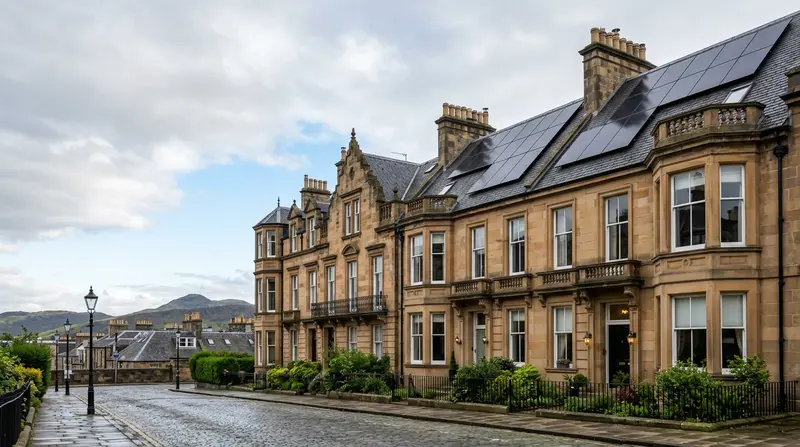
Solar Panels in Edinburgh's Old Town & New Town
Edinburgh's Old Town and New Town together form a UNESCO World Heritage Site, inscribed in 1995 in recognition of the remarkable contrast between the medieval Old Town, with its narrow closes and towering tenement lands, and the neoclassical New Town, laid out on a grid plan by James Craig from 1767. This dual inscription creates a unique planning environment for solar energy — but it does not mean solar panels are impossible. With the right approach, homeowners within the World Heritage Site can and do install solar PV.
UNESCO World Heritage Status & Solar Planning
The World Heritage Site designation means that City of Edinburgh Council applies heightened scrutiny to any alteration that affects the external appearance of buildings. The entirety of the Old Town (from Edinburgh Castle along the Royal Mile to Holyrood) and the New Town (from Princes Street north to Fettes Row and west to Haymarket) fall within the designated site and its buffer zone. This area is also covered by multiple overlapping conservation areas, including the Old Town Conservation Area and the New Town Conservation Area.
For solar installations, the practical effect is:
- Permitted Development Rights (PDR) do not apply — you cannot install solar panels on any building in the Old Town or New Town without a formal planning application to City of Edinburgh Council.
- Listed building consent is required for any alteration to a Category A or Category B listed building. Many Old Town tenement lands and virtually all New Town terraces are listed at Category A or B.
- Panels on rear-facing or concealed roof slopes — such as those facing into internal courtyards rather than the street — are significantly more likely to receive planning approval.
- In-roof (integrated) solar panels, which sit flush with the roof surface rather than being mounted above it on rails, may be preferred by planning officers as they reduce visual impact on the historic roofscape.
Housing Stock: Old Town & New Town
The housing stock in Edinburgh's Old Town is dominated by historic tenement lands — tall, stone-built residential blocks that line the Royal Mile, the Cowgate, the Grassmarket, and the narrow closes running between them. Many of these buildings date from the 17th and 18th centuries and are Category A listed. Roofs are typically steeply pitched natural slate, often with dormer windows, chimney stacks, and complex geometry that requires careful panel layout design.
The New Town's housing stock is very different: Georgian and early Victorian terraces and townhouses arranged in formal crescents, circuses, and grid streets. Properties on Charlotte Square, Heriot Row, Moray Place, and Drummond Place are among the most architecturally significant domestic buildings in Scotland. Roofs tend to be shallower-pitched than Old Town tenements, with lead flats, Welsh slate, and parapet walls. Category B listing is near-universal; Category A is common on principal elevations.
In both areas, scaffolding access is often challenging. Old Town closes can be too narrow for standard scaffolding rigs, requiring specialised access equipment. New Town rear lanes and basement areas can also restrict scaffold erection. Our installer partner conducts a detailed access survey before quoting.
Co-owner Consent in Tenements
If you own a top-floor flat in an Old Town tenement, the roof is typically held in common ownership by all proprietors in the building under the Tenements (Scotland) Act 2004. Installing solar panels on a shared roof is classified as an alteration to common property and requires the written consent of a majority of co-owners (or a different threshold if specified in your title deeds). Our installer partner manages this process, including drafting co-owner notification letters and collecting consents.
DNO: SP Energy Networks
Edinburgh is within the SP Energy Networks (SPEN) distribution area. For systems up to 3.68 kWp (single-phase), a simplified G98 notification is submitted to SPEN — confirmation typically comes within 10 working days. Systems above 3.68 kWp require a full G99 application (45–65 working days). In the Old Town and New Town, systems are often sized at or below 3.68 kWp due to limited roof area on individual flats, which keeps them within the faster G98 process.
Edinburgh Solar Yield
Edinburgh's average annual solar yield is 894 kWh per kWp of installed capacity (MCS data), above the Scottish median of 850 kWh/kWp. However, properties in the Old Town and New Town may see somewhat lower actual yields due to:
- Overshadowing from adjacent tall buildings — particularly in the narrow closes of the Old Town, where building heights of 6–8 storeys are common.
- Non-optimal roof orientation — many New Town terraces run east-west, meaning roof slopes face north and south rather than the ideal due south.
- Complex roof geometry — dormers, chimney stacks, and turrets reduce the usable roof area.
A shade analysis using satellite imagery is carried out during the survey to predict actual yield for your specific property.
City of Edinburgh Council Planning Process
For solar installations in the World Heritage Site, the planning process typically follows these steps:
- Pre-application enquiry (optional) — our installer can submit an informal enquiry to City of Edinburgh Council's planning department to gauge likely acceptance before committing to a full application.
- Full planning application — submitted via the ePlanning Scotland portal. The application includes roof plans, panel layout drawings, elevation drawings showing visual impact, and a heritage impact statement. A council planning fee applies; current fees are published by City of Edinburgh Council.
- Listed building consent (if applicable) — a separate application, also via ePlanning. No additional fee for householders. Consulted with Historic Environment Scotland for Category A listed buildings.
- Neighbour notification — City of Edinburgh Council notifies neighbouring property owners. A 21-day consultation period applies.
- Decision — typically issued within 8–12 weeks. Delegated decisions (by planning officers) are common for straightforward cases; contentious applications may go to the Development Management Sub-Committee.
Real Challenges of Solar in the Old Town & New Town
We believe in being upfront about the challenges specific to this part of Edinburgh:
- Slate roofs — most roofs are natural Scottish or Welsh slate. Removing and replacing slates for mounting rail installation requires specialist roofing skills. Our installer uses slate hooks that minimise slate removal.
- Scaffolding in closes and lanes — Old Town closes (such as Advocate's Close, Mary King's Close, and Fleshmarket Close) can be extremely narrow — some less than 2 metres wide. Scaffolding erection may require temporary closure orders from the Council. New Town rear access via mews lanes is usually easier but still requires planning.
- Co-owner consent — in tenement buildings with 8, 10, or even 20+ flats, obtaining majority consent can take time. Absent or unresponsive owners can delay the process.
- Planning refusal risk — particularly for street-facing installations on the principal elevation of listed buildings. This is why we recommend rear-facing or courtyard-facing panel positions wherever possible.
- Cost premium — scaffolding, access constraints, planning application fees, and specialist slate work mean installations in the Old Town and New Town usually cost more than equivalent systems in suburban Edinburgh. Every project is priced at survey, and the full cost is confirmed on your written quote.
Get an Old Town / New Town Solar Assessment
We install through MCS-certified partners. We'll assess your property for solar suitability, advise on planning requirements, and provide a no-obligation quote.
Request a surveyCall 0141 230 0198
Edinburgh Solar Hub is part of Scottish Energy Efficiency — an impartial advisory service, not an installer. We install through MCS-certified partners.
Solar Care Club — servicing for Edinburgh's solar owners
Already have solar panels? Keep your system running at peak performance with regular professional servicing and monitoring. The Solar Care Club is run by Scottish Energy Efficiency and available to solar owners across Scotland.
Watch
Priced at surveyConfirmed in writing
- 72-hour response time
- Performance monitoring
- Annual system health report
Care
Priced at surveyConfirmed in writing
- 24-hour response time
- Annual on-site inspection
- Performance monitoring
- System health report
Care Plus
Priced at surveyConfirmed in writing
- Same-day response time
- Annual on-site inspection
- Performance monitoring
- Priority booking for repairs
No contract. Cancel any time.
On-site visits are currently available in Edinburgh, Glasgow, and the Central Belt. Elsewhere in Scotland you can join Watch today and we'll tell you when we reach you.
Repairs are always quoted and charged separately.