GUIDE
Heat pumps for Edinburgh homes
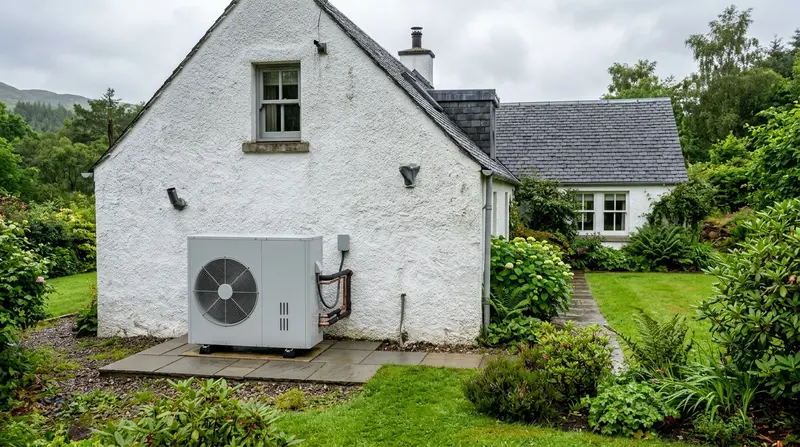
An air source heat pump can heat an Edinburgh home and its hot water using electricity far more efficiently than a direct electric heater. This guide explains how heat pumps work, which Edinburgh homes suit them (including tenements and conservation areas), what happens at the survey, and how you can pay. Loans available, subject to status.
How a heat pump works
An air source heat pump draws heat from the outdoor air — even below freezing — using a refrigerant cycle similar to a fridge working in reverse. It raises that heat to a useful temperature and passes it into your radiators, underfloor heating and hot water cylinder.
Efficiency is measured by the Coefficient of Performance (COP). A well-installed heat pump with a COP of 3.0 produces roughly three units of heat for every unit of electricity it uses. Heat pumps run at lower flow temperatures than gas boilers (typically 35–45°C), so they work best in well-insulated homes with suitably sized radiators.
Edinburgh’s mild maritime winters suit heat pumps well. Temperatures rarely fall far below freezing, and modern units keep working effectively in much colder conditions.
Is my Edinburgh home suitable?
Houses and bungalows
Detached, semi-detached and terraced houses are usually the most straightforward. You need outdoor space for the unit (a wall or ground position), indoor space for a hot water cylinder, and reasonable insulation.
Tenements and flats
Edinburgh’s tenements can be more challenging. Finding a suitable position for the outdoor unit, shared walls and back greens, and the need for agreement from other owners can all affect what is possible. Some flats may suit a smaller unit or an alternative system. The survey will tell you honestly whether a heat pump is practical.
Conservation areas and listed buildings
Much of central Edinburgh, including the Old Town and New Town, lies in conservation areas. Air source heat pumps can often be installed under permitted development, but there are conditions, and units visible from a public road or on a listed building may need planning permission or listed building consent from the City of Edinburgh Council. Your installer will advise on placement and whether an application is likely to be needed.
What happens at the survey
- A surveyor visits to measure rooms, check insulation, radiators and pipework
- A room-by-room heat loss calculation sets the right heat pump size
- The surveyor agrees positions for the outdoor unit and hot water cylinder
- Any radiator upgrades or insulation improvements are identified
- You receive a written quote — priced at survey, with the price confirmed on your written quote
- If you go ahead, installation typically takes 2–3 days, followed by commissioning and a handover
Paying for a heat pump
Loans available, subject to status. Some means-tested schemes exist for lower-income households, and we will tell you honestly if you might qualify. Running costs depend on your tariff, insulation and heating demand; any savings estimate is confirmed on your written quote.
Important: the Boiler Upgrade Scheme does not apply in Scotland
The Boiler Upgrade Scheme (BUS) is an England and Wales programme. It does not operate in Scotland.
Why MCS certification matters
MCS (Microgeneration Certification Scheme) is the UK quality standard for renewable energy installations. MCS-certified installers are assessed for technical competence and design their systems to MCS standards. We install through MCS-certified partners.
Warranty and guarantee terms are confirmed in writing on your quotation.
Find out if a heat pump suits your home
A no-obligation survey gives you a clear picture of suitability and a written quote. Loans available, subject to status.
Get my quote → or call 0141 230 0198